Lecture
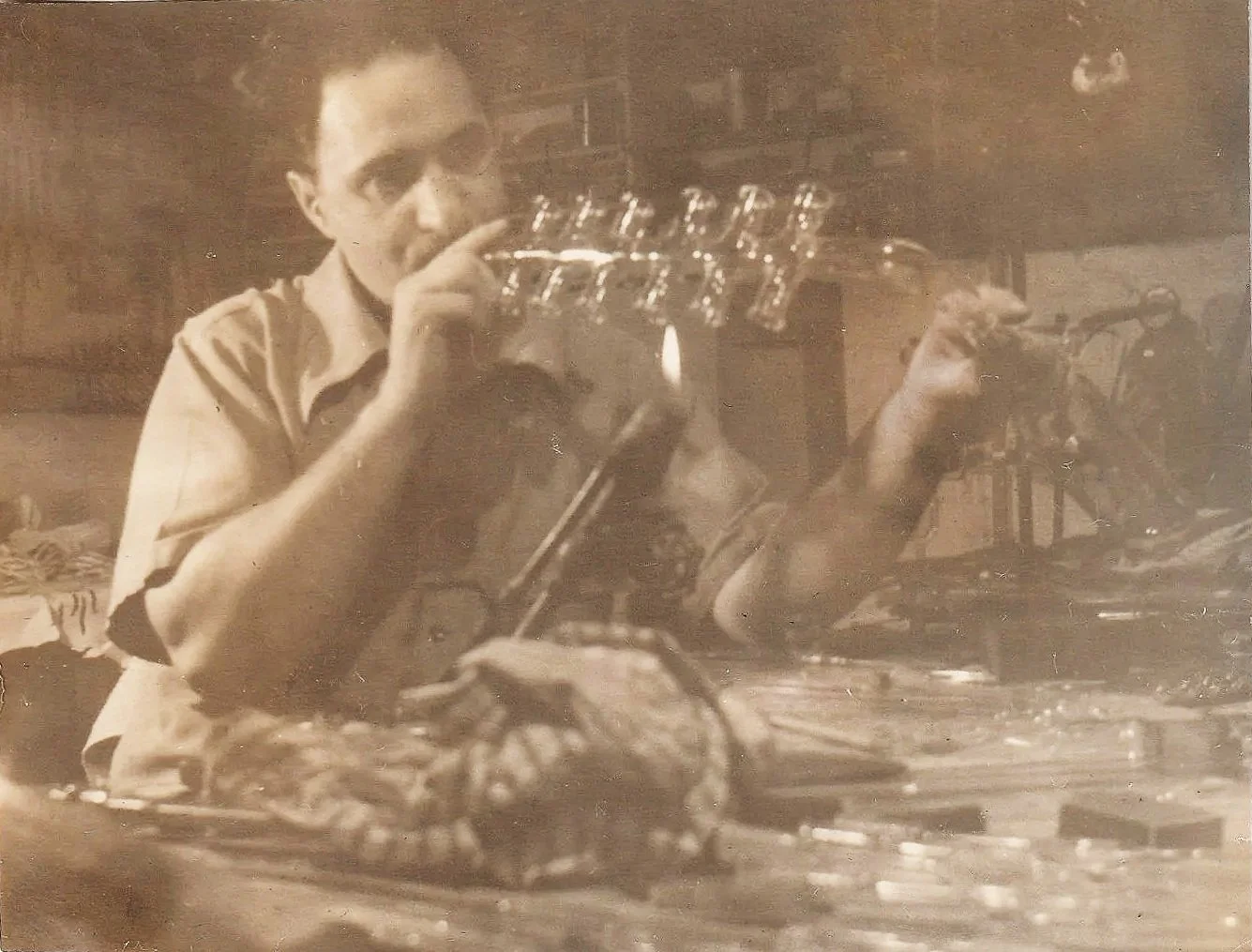
“The Art of Glassblowing” lecture by Elmo Maiolatesi at Johns Hopkins University
Thank you, Dr. Soria, Dear Friends:
Let me begin my telling you of my Italian Heritage. I am Italo-Americano, born in Wilkes-Barre, PA. My parents were both born of the Adriatic side of Italy. My father came from Sassoferrato in the province of Le Marche, and he was indeed a very proud Marchigiano. He was a tailor by trade but worked in the coal mines after coming to America. In later years, he again took up his trade as a tailor and worked in some of the well-known clothing stores in the Baltimore area. He retired from the U.S. Naval Academy’s Tailor Shop in Annapolis, MD.
My mother’s maiden name was Marsiglia. She came from Foggia. She also worked in various clothing stores and was retired by Hamburgers Clothing Store. Therefore, it is a fact that I cannot claim to have come from a long line of Venetian Glassblowers.
My parents eventually moved from Wilkes-Barre, PA. (the place of my birth to Scranton, PA. (A distance of about 20 miles north.) It was there that I grew up and attended public schools. I am the youngest of six children, three girls and three boys.
After graduating from Scranton Central High School, I enrolled in what is now “The University of Scranton.” Seeking employment to assist with my tuition, I answered an advertisement on the school’s bulletin board for a student to work on Saturdays to learn Glassblowing. I served as an apprentice with the Anthracite Laboratories and became seriously involved in the “Art of Glassblowing.” My childhood ambition, to attend Law School, and become a Lawyer, was dispelled by my fascination for the “Art of Glassblowing.”
With the outbreak of the War in 1941, my employment terminated with Anthracite Laboratories. Our product, hand-blown neon signs, was phased out because of the Government’s need for Mercury, which was used to illuminate signs.
After completing a period of training by the Brooklyn Thermometer and Hydrometer Company, I began to fabricate thermometers and hydrometers as a subcontractor for that company. Later, I responded to an advertisement in a scientific journal and applied for a position as a Glassblower with Sylvania Electric Products Corporation in Emporium, PA.
After reporting to work, I was called into conference with the Chief, Engineer who explained that my duties were to assist the Engineering Staff with the fabrication of a hand-blown glass cathode ray tube for the U.S. Government. We were admitted to a laboratory where I was shown a highly secretive electronic device connected to a cathode ray tube. He demonstrated this device by turning a few knobs and an image of a Glee Club appeared on the tube. After turning additional knobs, he enlarged the image of an individual within The Glee Club. These were the types of tubes that were to be hand-blown strictly for the war effort. The U.S. Government used them in conjunction with our radar system against the enemy. By now, you must have surmised that this tube was the infancy stage of what we now know as “Television.”
However, many hours of difficult work, glassblowing expertise, engineering, and numerous trial and errors were encountered to perfect these tubes. In addition, I fabricated intricate glass components for the high vacuum systems needed to evacuate and process tubes before their final testing and shipment to the U.S. Government. Sylvania Electric Products Corp recognized my efforts in the engineering and fabrication of these cathode ray tubes by presenting me with a commendation.
In 1941, I affiliated as Chief, Glassblower and Instructor with the staff at the Johns Hopkins University, Department of Chemistry, in Homewood. During my first years with the University, my work was, for the most part, Top Secret as we were under contract with the U.S. Government and were involved in the research of a part of the Atomic Bomb. In addition, my responsibilities included chemical, medical, physical, biological, and electronic glassblowing for the various departments. As an instructor in the Art of Glassblowing, I taught graduate students. Many of these students became knowledgeable glassblowers. Their knowledge helped them in the simple construction of scientific glassware which was needed for their research projects in preparing for their doctorate.
My work at the university afforded me the opportunity to come in contact with many Johns Hopkins Hospital staff members, doctors of international recognition. Specifically, I mention Dr. Blalock, the famous Johns Hopkins Hospital developer of the Blue Baby Method. Together we designed, and I fabricated a number of glassware used in his surgery and research. In particular, one was a simple, yet effective, suction cup for the removal of a tumor. Sometime later, Dr. Blalock asked me to confer with him and his assistant, Dr. Henry Bonson, who was in the process of developing the now famous Johns Hopkins Hospital artificial heart-lung apparatus. They were very anxious to begin the project and inquired if I could start fabricating their apparatus. When I informed them that my duties at the University made it impossible for me to fulfill their requirements, they suggested that I take the project home and fabricate the apparatus in the evenings and on weekends on a contract basis. Thus, beginning “The Maiolatesi Glass Company” Custom Glassblowers of Scientific Instruments for research of which I have been President for the past 35 years. Their project was completed, and the success of their method was reported in medical journals. In those articles, I was referred to as the manufacturer of the Hear-Lung Apparatus. Likewise, many pieces of scientific glassware for Johns Hopkins Researchers have been fabricated by me. In written reports of various projects, I was recognized in those medical journals as “The Glassblower, The Tool of Science.” In fact, I affiliated with the U.S. Naval Academy in Annapolis, Maryland. This was the beginning of my employment with the U.S. Government and the classified restrictions required of all civil service employees in Government Research Laboratories. Thus, I am unable to elaborate about my duties other than to say that I was a glassblower involved in naval research. In 1950, I transferred to the Department of Defense at the Chemical Systems Laboratory at the Edgewood Arsenal, I can tell you that I was awarded commendations for Outstanding Performances, one mentioned by Dr. Soria in my introduction, and hod Patents on several designs of glassware. When I retired on September 1, 1980, I had completed 33 years and 4 months service with the U.S. Government. Recently, I accepted the position of Consultant Glassblower at the Arsenal.
Now, I would like to elaborate somewhat about The Maiolatesi Glass Company. I manufacture scientific glass instruments and apparatus as I have for the past 43 years for Laboratories in Maryland, throughout the United States, and free world. For the most part, the orders that come from outside the Continental United States are from doctors who were serving their residency at the hospital while I was employed there. I am not a large manufacturer, but a small highly specialized glassblowing firm. On many occasions, I have been commissioned for the restoration or repairing of priceless antiques as well a valuable present-day glassware. For example, one particularly priceless antique that I restored a few years ago was a 400 BC old Roman goblet owned by a Baltimore banker who lived right here on Charles Street just a few blocks from the College of Notre Dame. Some of my prize creations are on display in the Wheaton Village Glass Museum in Millville, New Jersey. They consist of a glass candelabra, a Venetian style fluted centerpiece made from ordinary window glass, and a piece of my laminated dinnerware. My dinnerware is made from two round pieces of window glass between which is placed colored glass powder in various patterns. The round pieces of glass are then placed in a ceramic mold and heated slowly to a molten temperature. At the precise molten point, the furnace is shut off and allowed to cool slowly for 24 hours or until it is at room temperature. We use these plates in various stages of perfection as dinnerware at home. Plates of other designs have been hung as decorative pieces. Also, I sculpture glass in abstracts, flowers, religious objects, animals, jewelry, and in many miscellaneous art forms.
In closing, I would like to say that from the time I was first employed by the Anthracite Laboratories to the present (a span of 43 years), I have learned through experience many phases of glassblowing and consider myself a self-taught Artisan. To further give you some idea of the means I have pursed to improve my education in the field (there are Universities who have courses at the graduate level in glassblowing) I hold credits from the University of Alfred, College of Glass and Ceramics in Alfred, New York. There are numerous books on this subject of glass that I have read and studied. I am a Charter Member of The American Scientific Glassblowers Society. Through this society, the most learned men in my profession meet to exchange ideas. Yearly symposiums are attended by artisans from over the world. I have gone to Europe on four occasions. Each time, I have gone to Venice to observe the Venetian glassblowers at work. All of these things and more add to one’s knowledge but there is nothing and I repeat, nothing that teaches insight and expertise more than a sincere interest and many years of experience in one’s profession.
Finally, my friends, let me show you slides of some of my work and answer any question that you may have.